

Outperforming the Competition: The S-Drive Performance Trainer


Validating Superior Design
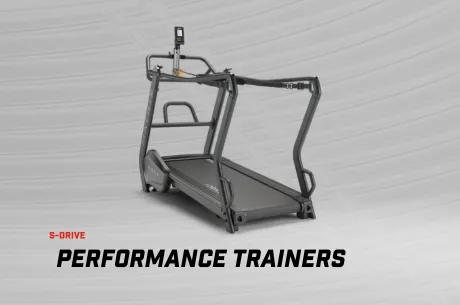
When developing the S-Drive Performance Trainer, Matrix Fitness aimed to outperform traditional training tools like motorized incline treadmills. To ensure that they achieved this design goal, Matrix commissioned an in-depth comparative study conducted by a professional biomechanics consultant. Leveraging a combination of accredited sources and scientifically validated testing procedures, the biomechanics consultant evaluated the caloric burn and muscle activation provided by the S-Drive resistance system against a motorized incline treadmill from a leading competitor. The results demonstrate that the S-Drive resistance system provides improved caloric burn when compared to the increased incline of a motorized treadmill. Additionally, the study found that the motorized treadmill did not provide a statistically significant increase in muscle activation when the incline increased.
Equating Incline to Resistance
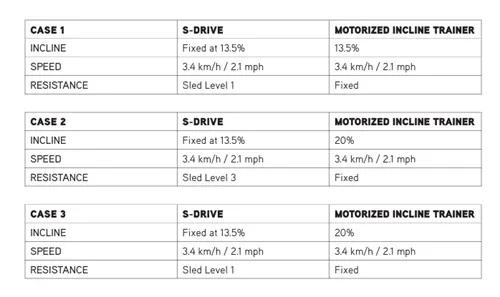
Without changing pace, adding incline and/or resistance can impact the level of difficulty of a treadmill workout. This study attempts to understand how adding resistance differs from increasing incline. To compare these effects, the S-Drive Performance Trainer was evaluated along with a motorized incline treadmill. The S-Drive has variable resistance and a 7-degree, fixed incline while the motorized incline treadmill has variable incline. Three conditions were compared as shown in the tables below. The first condition matched the incline and resistance of both treadmills as closely as possible. Since the competitive motorized treadmill measures incline in percent grade, the first step was to equate that to degrees of incline, which is how the fixed incline of the S-Drive is measured. Using an angle reader, the biomechanics consultant found that a 13.5% grade incline on the motorized treadmill is equivalent to the 7-degree fixed incline of the S-Drive. The second condition examined high resistance and high incline. Finally, the third condition compared low resistance to high incline. In all three cases, the consultant tested a range of healthy male and female adults who partake in physical activity 3–5 times per week. The consultant used VO2 data and heart rate to calculate calories burned and used electromyography (EMG) to measure muscle activity. After establishing static baselines for oxygen intake and heart rate, subjects then participated in the following randomized trials for five minutes each at 3.4 km/h / 2.1 mph with at least two minutes of rest between trials.
Calories Burned: Treadmill Incline vs. S-Drive Resistance
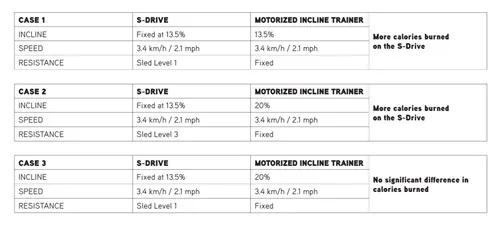
The first comparison made between the coordinating trials was the metabolic cost, or calories burned per minute. The two pairs were the S-Drive at resistance level 1 versus the motorized treadmill at 13.5% incline, then the S-Drive at resistance level 3 versus the motorized treadmill at 20.0% incline. After the trials, the amount of oxygen consumed and heart rate over the five-minute collection period were averaged with outliers excluded. Those averages were then used to calculate the calories burned per minute at a given resistance level or incline grade. In both pairs, there proved to be a statistically significant increase in the calories burned when walking on the S-Drive at resistance level 1 versus a 13.5% incline and when walking on the S-Drive at resistance level 3 versus a 20.0% incline. Furthermore, a final comparison demonstrated that there was no statistically significant difference in calories burned when walking on the S-Drive at resistance level 1 versus a 20.0% incline on the motorized treadmill.
Muscle Activation: Treadmill Incline vs. S-Drive Resistance
The second comparison made between coordinating trials was muscle activation levels and how they change when altering incline levels and when walking on a self-powered machine versus one that is motorized. Muscles tested via EMG included:
- Tibialis anterior
- Medial gastrocnemius
- Soleus
- Vastus lateralis
- Rectus femoris
- Semitendinosus
- Bicep femoris
- Vastus medialis
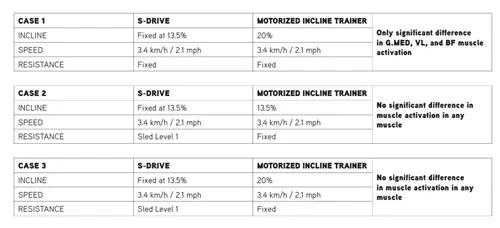
Testing revealed that there was not a statistically significant increase in muscle activation when walking on the S-Drive at resistance level 1 versus a 13.5% incline on the motorized treadmill. Furthermore, there was not a statistically significant increase in muscle activation when walking on the S-Drive at resistance level 1 versus a 20.0% incline on the motorized treadmill. Ultimately, the results demonstrate that there is no statistically significant increase in muscle activation when walking at either level of incline in comparison to the lowest level of resistance on the S-Drive.
Using Resistance to Maximize Training Results
The study shows that the S-Drive Performance Trainer uses resistance to provide a training experience equal to or more effective than training at an incline on a motorized treadmill from a leading competitor. In conclusion:
- When compared to incline training, S-Drive resistance training provides a statistically significant increase in oxygen consumption and heart rate, thereby demonstrating that S-Drive resistance training offers increased caloric burn over motorized treadmills used at an incline.
- Training at a 13.5% or 20.0% incline does not provide a statistically significant improvement in muscle activation versus the S-Drive at its lowest level of resistance.
- In general, subjects were able to burn more calories, with a similar muscle activation, on the S-Drive than on a motorized incline treadmill.

